Technical due diligence report example A finished technical due diligence report on a company that does not exist.

Below is a complete buy-side report, issued as Version 1.0, on Acme Corp for NorthBridge Capital, both of them invented.

What you are looking at

This is the report in the Report tab of the sample project that comes with every Percomb sandbox, in the format the product issues, and every finding traces to documents in that project.

The cover carries the fields that make a deliverable citable: who it was prepared for, the project, the artifact, the date, the revision and who prepared it.

It runs to twelve sections:

  1. Introduction
  2. Executive Summary
  3. Investment Areas
  4. Software
  5. Security
  6. People & Organization
  7. Architecture & Design
  8. Engineering Process
  9. Performance & Scalability
  10. Architecture, a reference section for the technical reader
  11. Code analysis, the repository statistics behind the findings
  12. Appendix

Six review areas are rated, with 18 findings among them, and the sample uses each of the composer's 26 block types at least once.

How to read it

THE REPORTPenetrationtesting has lapsedWarning · SecurityTHE SOURCE IT CITESPenTest_Q3_2024_Executive_Summary.pdf“Schedule quarterly pentest cadence”

Start with the recommendation

The Executive Summary opens on the verdict: proceed, with two conditions priced into the first-year plan, a tested disaster recovery capability within 100 days and key-person cross-training funded before close.

The ratings

Architecture & Design is Critical, with no tested way back from a regional failure. Software, Security and People & Organization are Warning, and Engineering Process and Performance & Scalability are Good.

The findings

A Warning or a Critical carries a path to green beside its evidence. "Penetration testing has lapsed" quotes the 2024 test report and says what would change the rating.

Four reading depths

Executive shows the conclusions and ratings, Management adds the reasoning and remediation plan, Technical adds the evidence and architecture, and Everything adds the appendices.

What the remediation costs

Investment Areas lists seven remediation actions with their effort, timeframe and cost, sequenced from the first 30 days to year one.

The code behind the findings

The Software section reads the repository against what management said, and the Code analysis section at the back holds the statistics behind it.

Sample report — fictional company

Technical Due Diligence Report

Project Falcon — Acme Corp

Prepared for
NorthBridge Capital (fictional)
Project
Project Falcon — Acme Corp
Artifact
Technical Due Diligence Report
Date
2026-07-15
Revision
Version 1.0
Prepared by
Thought Source

How to read the ratings

A review area’s rating consolidates the items assessed within it.

Good

As expected, or better. No remediation required; supports the deal objectives.

Warning

Management attention or investment required to bring the area up to expected standards.

Critical

Potential showstopper. Materially hinders the objectives without high-priority remediation.

Info

Information of interest — a note for the reader, not a defect.

In Progress

Partially assessed. The evidence base is still being gathered.

Introduction

Objective and context

NorthBridge Capital engaged Thought Source to perform technical due diligence on Acme Corp, a Series B spend-management platform, in support of a proposed growth investment. The deal thesis is that Acme Corp’s platform can carry a 5–10x increase in transaction volume over three years while expanding into enterprise accounts.

For that thesis to hold, three things have to be true: the platform must scale without re-architecture, the engineering organization must not depend on irreplaceable individuals, and the security and resilience posture must satisfy enterprise buyers. This report assesses each.

Approach

The review combined document analysis, working sessions and independent verification:

  • Data room review — architecture, organization and security documentation, including [1], [2] and [3]
  • Deep-dive sessions — six sessions with the CTO, VP Engineering and team leads
  • Source verification — repository analysis of contribution history, language composition and dependency health
  • Independent evaluation — hands-on use of the product in a trial tenant

Sources1.Acme_Architecture_Overview.md2.Org_Chart_Summary.md3.PenTest_Q3_2024_Executive_Summary.pdf

Evidence base

Documents reviewed

24

Data room and analyst files

Deep-dive sessions

6

CTO, VP Engineering, team leads

Repositories analyzed

12

Active, non-fork

Review areas

6

Assessed and rated

Session record

Management responses

Is there a tested disaster recovery plan?
We acknowledge the gap. Nightly snapshots run and a recovery runbook was drafted this quarter, but a full restore has never been exercised and RTO/RPO targets are not yet defined.

Sarah Chen, CTO · Session 2

What is the status of SOC 2?
Type I was completed in March 2026. The Type II observation window closes in October 2026; two enterprise prospects are contractually waiting on it.

Mike Ross, VP Engineering · Session 3

How is the payment gateway key-person risk being managed?
Tom W. is on the retention bonus program. Cross-training with a second engineer is scheduled for Q3 2026 but has not started.

Sarah Chen, CTO · Session 5

Executive Summary

Recommendation

Proceed, with two conditions priced into the first-year plan

The platform is modern, honestly engineered and has genuine headroom. The two material risks — untested disaster recovery and key-person concentration — are fundable, have credible remediation paths, and management acknowledged both without prompting.

On condition of

  1. 1.A tested disaster recovery capability within the first 100 days
  2. 2.The key-person cross-training program funded before close

Our conclusion

Acme Corp is a sound technical acquisition with two conditions.

The platform is modern, cloud-native and honestly engineered: services scale horizontally, delivery is automated, incidents are handled with discipline, and the team’s own documentation told us the same story our independent verification did — which is itself a signal about the engineering culture.

Two risks are material. First, resilience: the platform runs in a single region with no tested recovery path; a regional failure today would mean a multi-day, best-efforts restoration of a payments product. Second, concentration: payments, infrastructure automation and the legacy Python estate each depend on one or two named individuals.

Neither risk is structural. Both are fundable, both have credible remediation paths, and management acknowledged both without prompting. We recommend proceeding, with the investment areas in this report priced into the first-year plan.

Overall findings by review area

Review areaAssessmentKey findings and recommendations
SoftwareWarning

The code a buyer is acquiring is in good shape where it is new and honestly flagged where it is not. The debt is concentrated, known, and carried by too few people.

  • New platform code is healthy: TypeScript, reviewed, 78% covered
  • Legacy Python services carry the debt — 9% of the code, 12% coverage, two engineers
  • Coverage is measured but not enforced; the 61% average hides the split
SecurityWarning

Nothing found suggests weak security engineering — the one high-severity finding ever raised was fixed inside the testing window. What has slipped is the program around it: testing cadence, certification timeline, and two open items from 2024.

  • The most recent penetration test is 23 months old; its quarterly-cadence recommendation was never adopted
  • Application fundamentals are sound: IDOR remediated in-window, Auth0 for identity, no critical findings
  • SOC 2 Type II remains open with enterprise contracts waiting on it
People & OrganizationWarning

Three concentrations: Tom W. is the only engineer with deep payment-gateway knowledge; Alex J. solely owns the Terraform modules; two engineers carry the legacy Python estate. Retention bonuses exist for all named individuals — cross-training does not.

  • Attrition 8%, average tenure 3.2 years — healthy for the stage
  • Key-person concentration in payments, infrastructure and legacy services
  • QA capacity (5) lags the 22 feature engineers it supports
Architecture & DesignCritical

The architecture is the right one — and it all lives in one region with backups that have never been restored. For a payments product this is the single finding that must not survive the first hundred days.

  • No disaster recovery capability: snapshots untested, RTO/RPO undefined — critical
  • The service architecture itself is well designed and horizontally scalable
  • Single-region deployment concentrates the blast radius
Engineering ProcessGood

This is the strongest area of the review. Delivery is automated end to end, incidents are handled with a discipline unusual at this stage, and the process claims made in sessions are all visible in the delivery history.

  • CI/CD on every change; deploys are one reviewed merge away from production
  • Incident response is practiced, with on-call rotation and blameless postmortems
  • Change failure rate is low and stable
Performance & ScalabilityGood

Performance is a solved problem at the volumes the deal thesis requires. The April 2026 load test demonstrated 5x current peak with autoscaling engaging as designed.

  • p95 latency improved from 214ms to 161ms over the last six months
  • Load-tested to 5x current peak in April 2026 without intervention
  • 99.95% uptime over the trailing twelve months

Risk exposure

Impact →
1
3
2
4

Likelihood →

  1. 1Regional outage without tested recovery — multi-day restoration of a payments product
  2. 2Key-person departure — payments, infrastructure automation, legacy Python estate
  3. 3SOC 2 Type II slips past October 2026 — two enterprise contracts gated on it
  4. 4Legacy Python 2.7 estate stalls delivery — migration underway, 60% complete

Residual exposure with the controls in place today.

Deal-relevant risks

  • A regional outage before DR remediation would be revenue-impacting and, for a payments product, reputation-defining.
  • Departure of the payments engineer before cross-training completes would stall the integration roadmap by an estimated two quarters.
  • A SOC 2 Type II slip past October 2026 delays two enterprise contracts already in the pipeline.

Investment Areas

Every action below traces to a rated finding in this report. Effort is a rough order of magnitude for planning, not a quote. Sequencing reflects risk: resilience and key-person cover first, structural clean-up second.

Recommended investment

#AreaRecommendationEffortTimeframeCostEstimate
1Disaster recoveryDefine RTO/RPO, stand up a second availability zone, and run a full failover test.HighShort-termHigh6 person weeks + infra
2Payments key-person coverPair a second engineer with Tom W. through a full release cycle of the gateway.MediumShort-termMedium8 person weeks
3Security hygieneComplete the outstanding security headers and password policy from the Q3 2024 test.MediumShort-termLow2 person weeks
4Penetration test cadenceCommission a fresh test immediately and adopt the quarterly cadence the last report recommended.LowShort-termLowRecurring commitment
5Infrastructure ownershipSecond owner for the Terraform estate; rotate module changes through both.LowShort-termLow4 person weeks
6Legacy Python retirementMigration plan with named owners and dates for the remaining legacy services.HighMedium-termMedium12–16 person weeks
7Coverage enforcementGate CI on coverage for changed code; lift the legacy estate as it migrates.MediumMedium-termLow4 person weeks
7 recommended actions2 high effort · 5 short-term

Suggested sequencing

  1. Day 0–30·In progress

    First 30 days

    DR plan authored with RTO/RPO targets; security headers live; fresh penetration test commissioned.

  2. Day 90·Planned

    First quarter

    Failover tested end to end; payments cross-training underway; Terraform second owner in place.

  3. Month 6·At risk

    Month six

    Legacy Python migration started; first quarterly penetration test complete.

  4. Month 12·Planned

    Year one

    Coverage gates enforced in CI; second region live for the data plane.

Remediation phasing

Pre-close
First 100 days
H2 2026
2027
Resilience
DR design and funding
Second-region capability, tested
People
Cross-training program
Payments hiring
Platform
Python 2.7 retirement
SOC 2 Type II audit

Assumes current team capacity alongside business-as-usual delivery.

Investment areas — value against effort

Lower ← Deal value protected → Higher
Quick winsStrategic betsHousekeepingQuestion marks
Tested DR
Cross-training
SOC 2 Type II
Python 2.7 retirement
Observability uplift

Weeks ← Effort → Quarters

Positions reflect the estimates in the table above.

Disaster recovery — options considered

Backup-restore onlyWarm standby regionRecommendedActive-active
Meets 4-hour recovery objective
Meets enterprise buyer expectations
Engineering effortLowMediumHigh
Run cost$$$$$$$
Delivery riskLowMediumHigh

Costs are order-of-magnitude, per year, at current volumes.

Software

Warning

In summary

The code a buyer is acquiring is in good shape where it is new and honestly flagged where it is not. The debt is concentrated, known, and carried by too few people.

Key findings

  • New platform code is healthy: TypeScript, reviewed, 78% covered
  • Legacy Python services carry the debt — 9% of the code, 12% coverage, two engineers
  • Coverage is measured but not enforced; the 61% average hides the split

Assessment

Current state

The estate splits cleanly in two. The new platform — Node.js/TypeScript services on ECS Fargate — is consistently structured, reviewed on every change, and carries 78% test coverage. The legacy Python services that predate the 2024 re-platforming still handle enterprise report generation and two integration jobs; they are functional but thinly tested and, per [1], only two engineers remain familiar with them.

Gaps and risks

The risk is not the volume of legacy code (9% of lines) but the coupling of that code to revenue-relevant enterprise features and to two specific people. Coverage is measured in CI but nothing fails when it drops.

Evidence quality

Repository analysis corroborated the documentation: language composition, contribution concentration and coverage figures all match what management stated in sessions.

What this means for the buyer

Budget the migration now, while the two knowledgeable engineers are still in post. This is a funded-risk situation, not a rewrite.

Sources1.Org_Chart_Summary.md

Codebase at a glance

Lines of code

343k

Across 12 active repositories

Test coverage

61%

78% new platform, 12% legacy

Dependencies

1,842

23 with known CVEs

High CVEs open

3

No critical; patch path exists

What the review read

All 12 build units the review discovered resolved in full, so the figures below cover the whole of what was found. 12 repositories are in the signed review with 7 first-party dependencies between them; the build order places 1 package with no cycle. Of 120 third-party components: 99 ship, 3 only build and test, 18 undetermined. The shipping reading rests on: 3 confirmed from a release artifact, 1 absent from the release artifact, 104 read from the declared scope, 12 not evaluated. A reading confirmed from a release artifact outweighs one read from a declared scope, and both outweigh an assertion. 120 components were read from a resolved source (120 from a lockfile); none rests on a manifest declaration alone. 55 components are declared directly by a manifest and 65 are carried in by another component. Most of the estate is inherited, so an upgrade is usually a change to a direct dependency rather than to the affected component itself. 3 disclosure requests have been raised to the target: 0 drafted and not sent, 2 sent and awaiting an answer, 1 answered, 0 withdrawn. A request awaiting an answer is an open question, not a finding.

Licensing position

Of 99 components that ship: 78 permissive, 2 weak-reciprocal, 1 strong-reciprocal, 1 network-reciprocal, 15 commercial, 1 unrecognized, 1 unknown. 4 reciprocal-licensed components ship (2 weak-reciprocal, 1 strong-reciprocal, 1 network-reciprocal). Whether each one’s terms reach the proprietary code is the boundary reading in the findings; a strong or network-reciprocal component in what ships owes a source offer or an architectural separation. 4 license findings are open (2 license-unknown, 2 reciprocal-boundary). 3 license conclusions wait on a person; until they are decided the families above are the review’s proposals for those components. The network-reciprocal component in the hosted service is the one item that must be separated or removed before the deal; the GPL component owes a source offer unless the boundary separates it. Both are in the post-deal plan.

What the codebase is made of

Where the logic livesFilesLinesShare of lines
Source — behavior is in the file1,610249,00073%
Configuration driving an engine (CI, Terraform, deploy)26021,0006%
Declarative — specs, fixtures, locale data54073,00021%
Total2,410343,000100%

Working figures elsewhere in this report use the target’s own product code: 236,000 lines across 1,480 files — 22 vendored, 74 generated and 180 fixture files excluded. Growth in the declarative bucket is specification coverage, not bloat.

Where change concentrates

FileLinesAuthorsDirection (90 days)Work attracted
payment-gateway/…/settlement-engine.ts2,8501Being reduced (−380 lines)fix, hardening
ledger-service/…/posting-rules.ts2,1002Growing (+460 lines)feature, fix
reporting-jobs/…/report_runner.py1,6502Steadyfix, chore

Reported by exception — large, heavily changed and thinly staffed — never as a churn ranking. The kind of work a file attracts is the interpretive key: fix and hardening churn is control being established; feature churn is capability growing.

The commit record corroborates the remediation story

Good

Management’s claims about where engineering effort goes are checkable against the commit record, and they check out. The settlement engine — the single-author concentration — is being actively reduced under fix and hardening work (refactoring under way, down 380 lines in 90 days). The legacy Python files show no in-place reduction, which is consistent with the stated migrate-not-refactor strategy rather than contradicting it: the watch item there is migration pace, not candor. One growing platform file (posting-rules.ts) has no reduction evident and is flagged for refactoring.

  • Refactoring verdicts: 1 file refactoring-underway, 2 refactoring-recommended, from 1,140 measured decision-path source files.
  • "the migration is approximately 60% complete by service count" — migration plan, consistent with declining legacy commit volume.

Cited:Repository analysisLegacy_Python_Migration_Plan.docx
New platform code is healthy

Good

The post-2024 services follow one structure, pass review on every change, and carry 78% coverage. Naming, error handling and dependency hygiene are consistent across teams — the signature of enforced convention rather than individual heroics.

  • Repository analysis: 54% TypeScript, consistent service scaffold across 9 of 12 repositories.
  • "Backend: Node.js (Express) microservices running on ECS Fargate" — architecture overview, corroborated in code.

Cited:Acme_Architecture_Overview.mdRepository analysis

Legacy Python services carry the debt

Warning

Roughly 31,000 lines of pre-replatform Python still run enterprise report generation and two integrations. Coverage is 12%, the last substantive refactor was 2024, and only two engineers remain familiar with the code. The services are stable today; the risk is any forced change — a breaking API from an integration partner would land on two people.

Path to green — A dated migration plan with named owners for each remaining service, sequenced ahead of any integration-partner API changes. Estimated 12–16 person weeks.
High effort · High impact
  • "Legacy Python Services: Only 2 engineers familiar with codebase" — organization summary.
  • Commit history: legacy services received 120 commits in the last quarter against 1,690 to the new platform.

Cited:Org_Chart_Summary.mdRepository analysis

Coverage is measured, not enforced

Warning

CI reports coverage on every build but nothing fails when it falls. The 61% average is an artifact of the healthy/legacy split rather than a managed number.

Path to green — Gate changed-code coverage at 70% in CI; ratchet as the legacy estate migrates.
Medium effort · Medium impact
  • CI configuration reports coverage with no threshold; confirmed in session with the VP Engineering.

Cited:Deep-dive session 4

Legacy Python Services: Only 2 engineers familiar with codebase.
Org_Chart_Summary.mdThe organization’s own risk register agrees with the commit history — candor worth noting.

Stated basis

What this section assumed and left out. Each can be challenged.

  • How the code is distributed: a hosted service (weak assumption, full auto).
  • Which policy the code is judged against: the platform default policy (firm assumption, full auto).
  • How much of the history the figures read: all of it (firm assumption, full auto).
  • Which proposed license conclusions to accept: 3 license conclusions wait for 2 approvals each (firm assumption, full auto).
  • How the open findings are recorded: triage the findings by hand (decided by Sample Reviewer A).
  • Whether to draft disclosure requests for the findings that need the target: 3 requests drafted; 3 sent by a person, 1 answered so far (firm assumption, full auto).
  • Whether to run the Insights analysis so the history is checked against the documents: the Insights analysis was started (firm assumption, full auto).
  • Whether to draft the software section of the report: the report draft was started (firm assumption, full auto).

Security

Warning

In summary

Nothing found suggests weak security engineering — the one high-severity finding ever raised was fixed inside the testing window. What has slipped is the program around it: testing cadence, certification timeline, and two open items from 2024.

Key findings

  • The most recent penetration test is 23 months old; its quarterly-cadence recommendation was never adopted
  • Application fundamentals are sound: IDOR remediated in-window, Auth0 for identity, no critical findings
  • SOC 2 Type II remains open with enterprise contracts waiting on it

Assessment

Current state

The Q3 2024 test by Sample Testing Firm found no critical issues and one high (an IDOR, fixed and re-verified within the window). Identity is delegated to Auth0; payments to Stripe — both sensible boundaries for a team this size.

Gaps and risks

The 2024 report recommended a quarterly test cadence. No test has run since. Two medium findings from that report — security headers and password policy — were scheduled for late 2024 and their completion could not be evidenced. SOC 2 Type II is in its observation window with a hard commercial dependency.

Evidence quality

The penetration test report is independent and CREST-certified — strong evidence, but stale. Current-state security posture is management attestation plus our configuration review; a fresh test would convert both into fact.

What this means for the buyer

The gap is program discipline, not capability. It is cheap to close and should be closed before enterprise expansion makes it expensive.

Penetration testing has lapsed

Warning

The most recent independent test concluded in August 2024 — 23 months before this review. Its own first recommendation was a quarterly cadence. For a payments product heading into enterprise sales, an annual-at-minimum independent test is table stakes.

Path to green — Fresh test commissioned now; quarterly cadence contracted; the two 2024 items closed and verified.
Low effort · High impact
  • "Schedule quarterly pentest cadence" — recommendation 4 of the Q3 2024 report; no subsequent test exists.
  • Two of the report’s medium findings (headers, password policy) remain unevidenced as closed.

Cited:PenTest_Q3_2024_Executive_Summary.pdf

Application security fundamentals are sound

Good

Zero critical findings; the single high-severity issue (IDOR on the profile endpoint) was remediated and re-tested within the testing window. Identity via Auth0 with JWT claims checked server-side. The remediation speed says as much as the findings count.

  • "The single High severity finding was remediated during the testing window." — test conclusion.
  • "Overall Rating: PASS (with conditions)" — Sample Testing Firm.

Cited:PenTest_Q3_2024_Executive_Summary.pdf

Certification is behind the sales pipeline

Warning

SOC 2 Type I completed March 2026; the Type II observation window closes October 2026. Two enterprise prospects are contractually waiting. A slip converts a security formality into a revenue event.

Path to green — Treat the October window as a committed date with executive ownership; no scope changes to production controls until it closes.
Medium effort · High impact
  • Management response, session 3: two enterprise contracts conditioned on Type II.

Cited:Deep-dive session 3

The overall security posture has improved since Q1 2024. The single High severity finding was remediated during the testing window. No critical vulnerabilities were identified.
PenTest_Q3_2024_Executive_Summary.pdfIndependent and CREST-certified — but 23 months old. The finding here is the age, not the content.

People & Organization

Warning

Key person risk

Three concentrations: Tom W. is the only engineer with deep payment-gateway knowledge; Alex J. solely owns the Terraform modules; two engineers carry the legacy Python estate. Retention bonuses exist for all named individuals — cross-training does not.

Key findings

  • Attrition 8%, average tenure 3.2 years — healthy for the stage
  • Key-person concentration in payments, infrastructure and legacy services
  • QA capacity (5) lags the 22 feature engineers it supports

Assessment

Current state

Engineering is 45 people under an experienced CTO (ex-AWS) and VP Engineering, organized into platform, two product teams, QA and SRE. Retention metrics are strong and the organization chart matches what the commit history shows — the teams that own systems are the teams that change them.

Gaps and risks

The organization’s own summary names its three dependencies, and our repository analysis confirms each: payment-gateway commits are 86% one author; the Terraform estate is single-owner; the legacy Python services average two active committers.

Evidence quality

Strong — the org chart, retention data and commit history all agree.

What this means for the buyer

Retention agreements manage the probability of departure; only cross-training manages the impact. Fund the latter.

Engineering structure

39 FTE across 5 groups

Product Team A — consumer

Distributed

12

React, Node.js, TypeScript. Owns the consumer surface.

Product Team B — enterprise

Distributed

10

Python, GraphQL, integrations. Carries the legacy estate.

Single point of failure

Platform

Distributed

8

Kubernetes, AWS, Terraform. Terraform modules single-owner (Alex J.).

Single point of failure

QA / SDET

Distributed

5

Test automation and performance testing for both product teams.

Hiring: +2 recommended

DevOps / SRE

Distributed

4

CI/CD, monitoring, incident response. Healthy on-call rotation.

Individual contributors by group; leadership (CTO, VP, leads) excluded. Total 39 ICs of 45 in engineering.

Engineering allocation

Individual contributors by functional group.

Reporting lines

Sarah Chen — CTOSarah ChenCTOMike Ross — VP EngineeringMike RossVP EngineeringProduct Team A — 12 engineersProduct Team A12 engineersProduct Team B — 10 engineersProduct Team B10 engineersLegacyPlatform — 8 engineersPlatform8 engineersRiskQA / SDET — 5 engineersQA / SDET5 engineersDevOps / SRE — 4 engineersDevOps / SRE4 engineers
Engineering leadership and the key-person dependencies, marked in place.

Knowledge concentration in three named places

Warning

Payments (Tom W.), infrastructure automation (Alex J.) and the legacy Python services (two engineers) each lack a second owner. Any single departure is absorbable; a payments departure before cross-training would stall the integration roadmap by an estimated two quarters.

Path to green — Pair a second engineer through a full gateway release cycle (8 person weeks); rotate Terraform changes through a second owner (4 person weeks).
Medium effort · High impact · VP Engineering
  • "Payment Gateway: Single engineer (Tom W.) has deep knowledge" — organization summary.
  • "Infrastructure: Alex J. is sole owner of Terraform modules" — organization summary.
  • Commit analysis: 86% of gateway commits by one author over 24 months.
  • Hotspot analysis names the file: settlement-engine.ts is single-author across 214 commits — the concentration is in the commit record, not just the org chart.

Cited:Org_Chart_Summary.mdRepository analysis

Retention and tenure are healthy

Good

Attrition of 8% and average tenure of 3.2 years are strong for a Series B. A retention bonus program covers the top 15%, including every named key person.

  • "Last 12-month attrition: 8%. Average tenure: 3.2 years." — organization summary.

Cited:Org_Chart_Summary.md

QA capacity lags the feature teams

Warning

Five QA/SDET engineers support twenty-two feature engineers. The automation-first approach partly compensates, but release-window regression checks are already the stated bottleneck and enterprise expansion will widen the surface.

Path to green — Two QA hires, or an embedded-SDET model with headcount moved from the product teams.
Medium effort · Medium impact
  • Session 4: release regression named as the current bottleneck by the VP Engineering.

Cited:Deep-dive session 4Org_Chart_Summary.md

Key-person exposure — today and after cross-training

Today

  • Payments: one engineer holds effective ownership
  • Infrastructure automation: two named individuals
  • Legacy Python estate: single maintainer

After the funded program

  • Every critical system has at least two capable owners
  • Runbooks exercised quarterly through game days
  • Payments team of three, hiring complete

Architecture & Design

Critical

In summary

The architecture is the right one — and it all lives in one region with backups that have never been restored. For a payments product this is the single finding that must not survive the first hundred days.

Key findings

  • No disaster recovery capability: snapshots untested, RTO/RPO undefined — critical
  • The service architecture itself is well designed and horizontally scalable
  • Single-region deployment concentrates the blast radius

Assessment

Current state

React SPA delivered via CloudFront; Node.js microservices on ECS Fargate behind an API gateway; Aurora PostgreSQL with a read replica; Redis for caching; SQS for asynchronous work. Identity and payments are delegated to Auth0 and Stripe. This is a textbook mid-stage SaaS architecture, and it is actually implemented as documented.

Gaps and risks

Everything runs in one region. Nightly snapshots exist but a restore has never been exercised; recovery objectives are undefined. The DR plan summary requested in the data room was never provided — because, as management confirmed, it does not yet exist.

Evidence quality

Architecture documentation matched our independent review. The DR gap is established by management’s own acknowledgment, which is the strongest form of adverse evidence.

What this means for the buyer

The remediation is well-trodden AWS work, not a re-architecture. It is a condition, not a concern.

No disaster recovery capability

Critical

Nightly Aurora snapshots run, but no restore has ever been exercised, recovery time and point objectives are undefined, and the whole platform occupies a single region. A regional failure means best-efforts reconstruction of a payments product, measured in days.

Path to green — Define RTO/RPO with the board; restore into a second AZ within 30 days and prove it; quarterly failover tests thereafter; second region within the year.
High effort · High impact · CTO
  • "Disaster Recovery Plan summary" — data-room request outstanding at close of review.
  • Management, session 2: runbook drafted, never tested; RTO/RPO not defined.

Cited:Request listDeep-dive session 2

The service architecture is sound

Good

Stateless services on Fargate scale horizontally; async work is queued; data access patterns separate read and write load. Nothing in the design blocks the 5–10x volume thesis.

  • Architecture overview corroborated by configuration review and the April 2026 load test.

Cited:Acme_Architecture_Overview.md

Single-region deployment

Warning

Only the CDN is multi-region; compute and data sit in one region. Distinct from the DR finding: even with tested recovery, steady-state resilience would still depend on one region’s health.

Path to green — Second availability zone now; active/warm second region as enterprise SLAs demand it.
High effort · Medium impact
  • Infrastructure configuration review; confirmed in session 2.

Cited:Deep-dive session 2

Deployment today

SINGLE AWS REGIONCloudFront CDN — multi-region edgeCloudFront CDNmulti-region edgeAPI GatewayAPI GatewayECS Fargate services — Node.jsECS Fargate servicesNode.jsAurora PostgreSQL — primary + replicaAurora PostgreSQLprimary + replicaRiskElastiCache RedisElastiCache RedisSQS queuesSQS queuesAuth0 — identityAuth0identityStripe — paymentsStripepaymentsSnapshots exist but a restorehas never been exercised.
Everything below the CDN lives in a single region — the shape of the critical finding.

Engineering Process

Good

In summary

This is the strongest area of the review. Delivery is automated end to end, incidents are handled with a discipline unusual at this stage, and the process claims made in sessions are all visible in the delivery history.

Key findings

  • CI/CD on every change; deploys are one reviewed merge away from production
  • Incident response is practiced, with on-call rotation and blameless postmortems
  • Change failure rate is low and stable

Assessment

Current state

Work flows through short-lived branches, mandatory review, and automated build, test and deploy. Fargate services ship multiple times per week. Monitoring is centralized in Datadog with SLO-based alerting and a real on-call rotation.

Gaps and risks

Architectural documentation is thinner than the operational discipline — decisions live in people and pull requests rather than in records. Not rated as a finding on its own, but worth an ADR habit as the team grows.

Evidence quality

High: pipeline configuration, deployment history and three recent postmortems were all provided and are consistent.

What this means for the buyer

Integration risk from process mismatch is low. Preserve this culture; do not standardize it away.

Delivery is genuinely automated

Good

Every change passes automated build and test before a reviewed merge; deployment to production is push-button from the pipeline. No manual steps were identified between merge and release for the Fargate services.

  • Pipeline configuration review; deployment history shows 9–14 production releases per week.

Cited:Deep-dive session 4

Incident response is practiced, not aspirational

Good

On-call rotation across SRE and senior engineers, SLO-based alerting, and blameless postmortems with tracked actions. The three most recent postmortems show root causes addressed, not just documented.

  • Three postmortems reviewed; all corrective actions closed within a sprint.

Cited:Deep-dive session 4

Change failure rate is low

Good

Roughly 2% of production deployments in the last two quarters required rollback or hotfix — comfortably inside the range expected of a disciplined team at this cadence.

  • Deployment and rollback history, Q1–Q2 2026.

Cited:Repository analysis

Engineering maturity

Assessed maturity today against the target operating level for an enterprise-grade platform.

Performance & Scalability

Good

In summary

Performance is a solved problem at the volumes the deal thesis requires. The April 2026 load test demonstrated 5x current peak with autoscaling engaging as designed.

Key findings

  • p95 latency improved from 214ms to 161ms over the last six months
  • Load-tested to 5x current peak in April 2026 without intervention
  • 99.95% uptime over the trailing twelve months

Service levels, trailing 12 months

Uptime

99.95%

Against a 99.9% SLO

p95 latency

161ms

June 2026, all APIs

Peak load

1.8krps

Load-tested to 9k rps

Error rate

0.04%

5xx responses, June 2026

p95 API latency, January–June 2026

Steady improvement as read-heavy endpoints moved to the replica and cache hit rates rose.

Demonstrated headroom beyond the thesis

Good

The April 2026 load test sustained 5x current peak for four hours with autoscaling engaging as designed and no manual intervention. The 10x case is credible with the planned read-path caching work.

  • Load test report, April 2026: 9,000 rps sustained, p95 within SLO throughout.

Cited:Deep-dive session 6

The database is the eventual constraint

Info

Aurora with a single read replica is comfortably inside limits today. Past roughly 10x volume, write throughput on the ledger tables becomes the constraint to plan for — an ordinary scaling problem, flagged here for the roadmap rather than as a risk.

  • Load test telemetry: writer CPU at 34% during the 5x sustained run.

Cited:Deep-dive session 6

Architecture

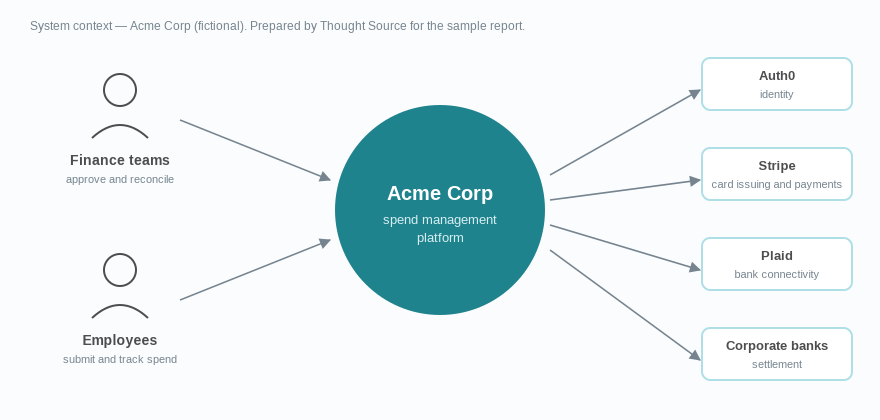
System context

Context diagram showing finance teams and employees using the Acme Corp platform, which integrates with Auth0, Stripe, Plaid and corporate banks.
Acme Corp in its environment: who uses it and what it depends on.Source: Thought Source analysis

Logical architecture

User-facing

Web appReact SPA
Admin consoleReact
Public APIREST

Services

Payments serviceNode.jsRisk
Ledger serviceNode.js
Workflow serviceNode.js
Reporting jobsPythonLegacy
NotificationsNode.jsNew

Data

Aurora PostgreSQLPrimary + replica
ElastiCache RedisCache
S3Documents

External

Auth0Identity
StripePayments
PlaidBank data
Observability
AuthZ
Components by layer. Flags mark the legacy estate and the key-person-dependent payments service.

Reading the diagram

The risk flag on the payments service marks the key-person dependency assessed in People & Organization, not a design defect. The legacy flag marks the Python estate whose migration is costed in Investment Areas. Cross-cutting identity and observability apply at every layer.

Architecture in four points

Scale-out by design

Stateless services behind a load balancer; the April 2026 load test held 5x current peak with autoscaling engaging as designed.

One region, one weakness

Every component runs in a single region. Resilience within the region is genuine; recovery beyond it is untested.

Infrastructure as code

The full environment rebuilds from Terraform; drift is caught in CI. Two named individuals hold the deep knowledge.

Observability that answers questions

Traces, metrics and logs are correlated; the on-call engineer can move from an alert to a cause in minutes.

A sound cloud architecture whose one structural gap — regional failure — is priced in the investment plan.

Code analysis

Method

Twelve active repositories analyzed over 24 months of history: language composition, contribution concentration, and change distribution. Forks and archived repositories excluded. Figures below are the evidence base for the Software and People findings.

Repository statistics

Language distribution

LanguageFilesLines of codeShare
TypeScript1,240186,00054%
JavaScript61089,00026%
Python14031,0009%
SQL9013,0004%
Terraform12012,0003.5%
Other21012,0003.5%
Total2,410343,000100%

Lines of code across the 12 active repositories.

Commits by quarter

Investment is shifting out of the legacy estate — the migration is already underway organically.

Contribution concentration, trailing 24 months

ContributorCommitsShareNote
Tom W.3,18022%86% of payment-gateway commits
Priya N.2,64018%Ledger and workflow services
Alex J.2,35016%Sole Terraform owner
Lena K.1,98014%Consumer web
Ten others4,31030%No further concentration
Total14,460100%

Share of commits by author. Concentrations corroborate the organization’s own key-person register.

The stack at a glance

Product

TypeScriptNode.js 20React 18GraphQL· partner API

Data

PostgreSQL 15· ledger of recordRedis· queues + cacheS3· documents

Legacy estate

Python 2.7 serviceslegacy· migration 60% completeCron-based reconcilerrisk· replacement scheduled

Delivery

GitHub ActionsTerraformKubernetesnew· EKS

A current, boring-in-the-good-way stack; the Python 2.7 tail is the only estate risk and it is shrinking.

Appendix

The review team

SA

Sample Reviewer A

Project lead

Twenty years leading independent technology reviews for investors and acquirers across SaaS, payments and infrastructure.

SB

Sample Reviewer B

Technical lead

Former CTO and hands-on architect; led the source, architecture and operations review threads on this project.

SC

Sample Reviewer C

Software analysis

Specialist in source and dependency analysis; produced the quantitative evidence base behind the software findings.

What the sample cannot show you

  • Citations that open the source at its page, line range or transcript timestamp.
  • The work underneath: the request list, the documents, Insights and the source-code readings, all in your sandbox copy.
  • The review stage on every block (Draft, Reviewed, Revised or Analyst), so a reviewer sees what nobody has read yet.
  • An issued report at a link, as a numbered version, with named readers who each accept a confidentiality and non-reliance gate before the first page opens.

What a report like this takes

A report like this isn't written by filling in headings. Every rating, finding and cost in it traces back to a page in the target's own material, and the questions behind it were written by practitioners over hundreds of completed transactions.

Percomb produces it from your deal. It starts from a request list of 80 items in 16 sections, cites only the target's own material, and where the material is silent it says so and asks for what's missing. To see that happen on a full project, open the sample project or take the tour.

See the project behind the report

  • Open your own copy. A private sandbox with this project inside it, from the indexed documents to the issued report. The link arrives at your work email, and the copy clears itself a day after you last touch it.
  • Take the tour. A fictional acquisition replayed in five scenes, from the first question to the issued report, in about four minutes and with no account.

For a live deal, practitioners lead the diligence on Percomb, and the pricing page sets out the ways to engage.

Questions

Frequently asked questions

Is this a real technical due diligence report?

No. Acme Corp, its people, its numbers and the fund that commissioned the review are all invented, and every finding traces to documents in the sample project.

What does a technical due diligence report include?

A verdict and its conditions, a rating for each review area, findings with their evidence, the remediation they imply with its effort and cost, and an appendix on how the work was done. This sample rates six of the twelve review areas Percomb can rate.

Is this a template?

No. It's an example of a finished report, produced by Percomb from a fictional company's material. What makes it useful is the evidence under each finding, and that comes from your own deal.

Who prepared it?

The cover says Thought Source, as it would on a deliverable our practitioners sign. The review team named in the appendix is fictional.

Can I download it?

Percomb does not send reports as files. A report lives at a link, where every correction reaches every reader, so the sample lives on this page and in your sandbox.

How is a report like this produced in Percomb?

Sections are drafted from the project's own evidence and arrive as Draft, and an analyst reviews, revises and issues them as a numbered version. A question the evidence cannot answer is reported as a gap and added to the request list.